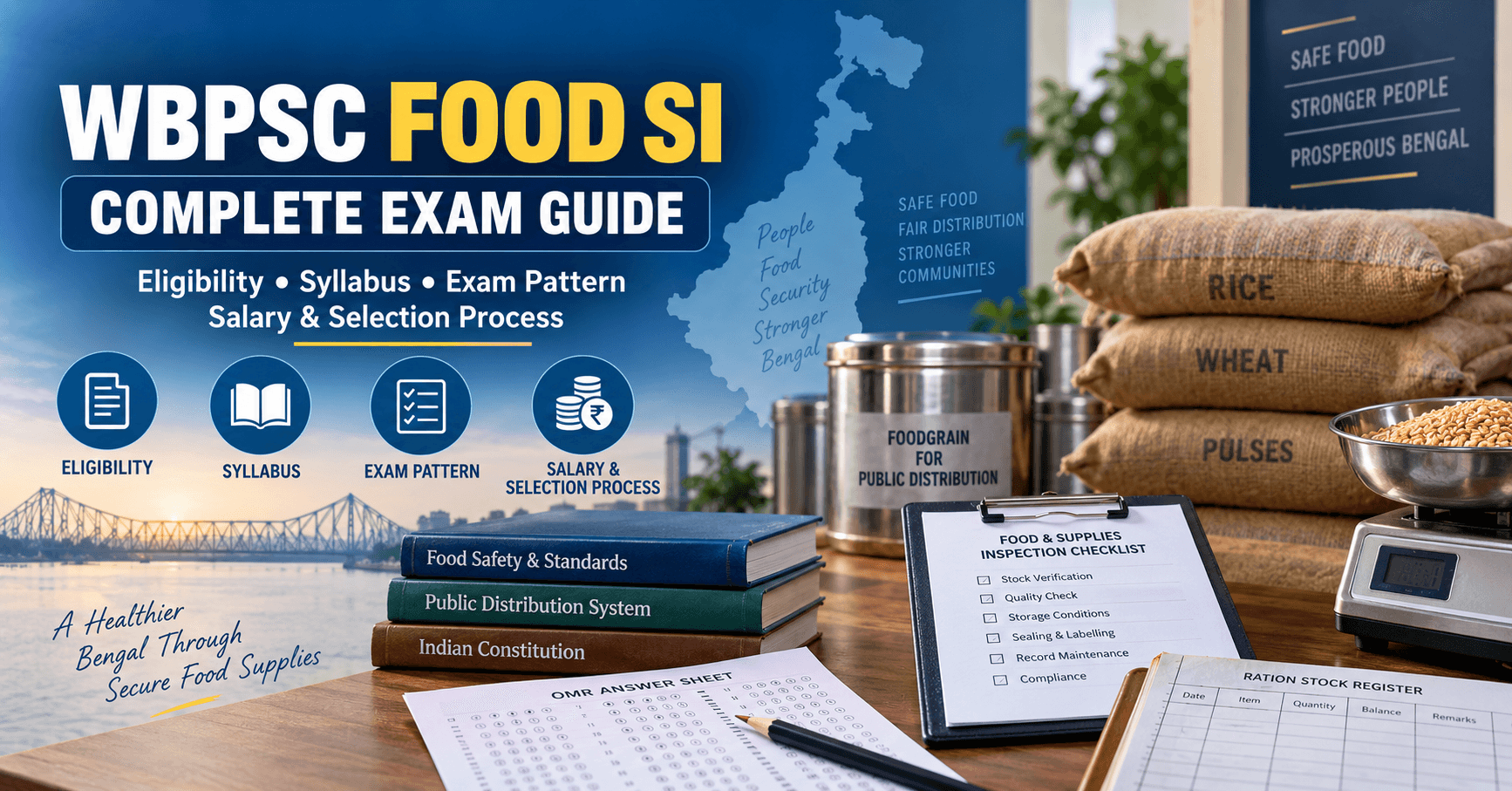
WBPSC Food SI: A Practical Guide for Aspirants
The WBPSC Food SI examination is one of West Bengal’s most widely followed government recruitment examinations. Its popularity is easy to understand: the minimum academic qualification has traditionally been at the Madhyamik level, while the post offers a regular state government career involving both office and field responsibilities.
The full name of the post is Sub-Inspector in the Subordinate Food and Supplies Service, Grade III, under the Food and Supplies Department, Government of West Bengal.
Although candidates commonly call it the “Food SI exam,” recruitment is conducted by the West Bengal Public Service Commission, or WBPSC.
This guide explains the eligibility criteria, previous examination pattern, syllabus, salary, duties and selection process in clear terms.
> Important: This is a general exam guide, not a notification for an active recruitment cycle. WBPSC may change the vacancies, dates, age conditions, fees, examination scheme or eligibility requirements in a future advertisement.
What Is the WBPSC Food SI Post?
A Food SI is a field-level employee working under the West Bengal Food and Supplies Department.
The work is connected with the implementation and monitoring of the public distribution system. Depending on the posting, a Food SI may inspect ration shops, verify records, examine stocks, assist with enquiries and prepare reports for senior officers.
This is not a uniformed police post. The “SI” in its name refers to Sub-Inspector within the Food and Supplies Service.
Who Conducts Food SI Recruitment?
Recruitment is conducted by the West Bengal Public Service Commission.
Candidates should use the official WBPSC website to check:
- Recruitment advertisements
- Application schedules
- Examination dates
- Admit cards
- Answer keys
- Results
- Personality-test schedules
- Recommendations and other notices
Third-party websites can be useful for preparation, but an official WBPSC notice should be treated as the final authority.
WBPSC Food SI Eligibility Criteria
The detailed eligibility conditions are announced separately for each recruitment cycle. Based on the previous major Food SI recruitment, the essential requirements included academic qualification, language ability, age eligibility and physical fitness for the nature of the work.
Educational Qualification
In the previous recruitment, candidates were required to pass the Madhyamik examination conducted by the West Bengal Board of Secondary Education or an equivalent examination recognised by the competent authority.
This means a graduate degree was not compulsory under that advertisement.
Candidates possessing higher qualifications could apply, provided they also satisfied all the essential conditions mentioned in the notification.
A future advertisement may change the qualification requirement. Candidates should not apply solely on the basis of an earlier recruitment cycle.
Language Requirement
Candidates were required to have the ability to read, write and speak Bengali.
A different provision may apply to candidates whose mother tongue is Nepali, subject to the language conditions stated in the official advertisement.
Candidates should read this section of the notification carefully. Language eligibility is an essential condition rather than a preference.
Age Limit
Under the previous recruitment framework, the general age range was:
- Minimum age: 18 years
- Maximum age: 40 years
The age was calculated according to the cut-off date specified in the advertisement.
Upper-age relaxation was available to eligible candidates belonging to reserved or specially recognised categories in accordance with West Bengal Government rules. These could include:
- Scheduled Caste candidates
- Scheduled Tribe candidates
- Other Backward Class candidates
- Persons with disabilities
- Ex-servicemen
- Other categories covered by the applicable rules
The category, extent of relaxation and certificate requirements must be checked in the current notification. Relaxation rules applicable to candidates from West Bengal may not automatically apply to reserved-category candidates from another state.
Nationality and Other Conditions
Applicants are generally required to be Indian citizens or otherwise satisfy the nationality conditions prescribed by the commission.
Candidates must also be suitable for the duties of the post. Since a Food SI may have to perform field inspections and travel within the area of posting, the commission or appointing authority may prescribe standards relating to health and physical fitness.
Previous WBPSC Food SI Exam Pattern
The previous Food SI selection process consisted of:
- A written examination
- A personality test
- Verification of eligibility and documents
- Preparation of the final merit list
The written examination was objective in nature.
| Examination Component | Marks |
|---|---|
| General Studies | 50 |
| Arithmetic | 50 |
| Written Examination Total | 100 |
| Personality Test | 20 |
| Overall Total | 120 |
The written paper contained multiple-choice questions and had a duration of approximately 90 minutes under the previous scheme.
Candidates should confirm the number of questions, duration and marking rules from the notification and examination instructions issued for their own recruitment cycle.
Is There Negative Marking?
The previous examination instructions provided for negative marking for incorrect answers.
The precise deduction should always be verified from the current WBPSC advertisement, admit card or examination instructions. Candidates should not assume that a marking rule from an older examination will remain unchanged.
When negative marking applies, random guessing can reduce the final score. It is usually better to attempt a doubtful question only after eliminating the clearly incorrect options.
WBPSC Food SI Syllabus
The written examination broadly covers two areas:
- General Studies
- Arithmetic
The standard of the questions has traditionally been associated with the level expected from a Madhyamik-qualified candidate, though competition can make the actual paper challenging.
General Studies Syllabus
The General Studies section examines a candidate’s awareness of the world, India and West Bengal.
Important areas may include:
General Knowledge
- Important national and international events
- Indian states, capitals and geographical features
- Major institutions and organisations
- Awards and honours
- Books and authors
- Important days
- Sports
- Science in everyday life
Indian History
- Ancient Indian history
- Medieval Indian history
- Modern Indian history
- British rule in India
- Social and religious reform movements
- Indian freedom movement
- Important leaders and organisations
Geography
- Physical geography of India
- Rivers, mountains and climate
- Agriculture and natural resources
- Population and transport
- Geography of West Bengal
- Districts and important places of West Bengal
Indian Polity
- Constitution of India
- Fundamental Rights and Duties
- Parliament
- President and Prime Minister
- Supreme Court and High Courts
- State Government
- Governor and Chief Minister
- Panchayati Raj and local administration
Economy
- Basic economic concepts
- Indian agriculture
- Inflation and unemployment
- Government schemes
- Banking and financial awareness
- Poverty and development
- Public distribution system
General Science
- Basic Physics
- Basic Chemistry
- Biology and human health
- Environment and ecology
- Everyday scientific phenomena
- Nutrition and food-related awareness
Current Affairs
Candidates should follow significant developments concerning:
- India
- West Bengal
- Government programmes
- Economy
- Science and technology
- Environment
- Sports
- Awards
- Important appointments
Current affairs should be studied with context. Memorising a name without understanding why it appeared in the news is often not enough.
Arithmetic Syllabus
The Arithmetic section tests basic numerical ability and problem-solving speed.
Important topics generally include:
- Number system
- Simplification
- Highest Common Factor and Lowest Common Multiple
- Fractions and decimals
- Ratio and proportion
- Percentage
- Average
- Profit and loss
- Discount
- Simple interest
- Compound interest
- Partnership
- Time and work
- Pipes and cisterns
- Time, speed and distance
- Trains
- Boats and streams
- Mensuration
- Basic algebra
- Age-related problems
- Mixture and allegation
- Unitary method
Candidates should first understand the method and then practise solving questions without lengthy calculations.
Selection Process Explained
A candidate does not receive final selection merely by passing the written examination. The process generally moves through several stages.
Stage 1: Written Examination
All eligible applicants appear for the objective written examination.
The written test is important because it contributes the largest share of marks to the final merit calculation.
Stage 2: Shortlisting
WBPSC shortlists candidates for the personality test according to their written marks, category and the criteria fixed by the commission.
The number of shortlisted candidates may depend on the number of vacancies and the recruitment rules.
Stage 3: Personality Test
The personality test carried 20 marks under the previous scheme.
It may assess:
- General awareness
- Communication ability
- Understanding of the Food SI post
- Knowledge of West Bengal
- Awareness of the public distribution system
- Confidence and presence of mind
- Suitability for public-facing and field duties
Candidates may also be asked questions based on their educational background, home district, interests or current affairs.
Stage 4: Document Verification
Candidates must establish that they fulfilled every eligibility condition by the required date.
Documents may include:
- Madhyamik admit card or age proof
- Madhyamik mark sheet and certificate
- Higher qualification documents
- Valid photo identity proof
- Caste or category certificate
- Disability certificate, where applicable
- Address or nationality-related documents
- Application form
- Personality-test call letter
- Passport-size photographs
- Other documents requested by WBPSC
Names, dates of birth and category details should be consistent across the application and supporting records.
Stage 5: Final Merit List
The final merit list is generally prepared using the combined marks obtained in the written examination and personality test.
Final recommendation remains subject to:
- Category-wise vacancy availability
- Verification of eligibility
- Validity of certificates
- Medical fitness
- Character and antecedent verification
- Other appointment conditions
WBPSC Food SI Salary
Under the previous advertisement, the post carried a pay scale under Pay Level 6, with basic pay ranging from approximately:
₹22,700 to ₹58,500
The exact monthly salary depends on the employee’s basic pay, admissible allowances and deductions.
A Food SI may receive applicable benefits such as:
- Dearness Allowance
- House Rent Allowance
- Medical allowance or benefits
- Other admissible state government allowances
Deductions may include contributions under the applicable retirement system, professional tax, income tax and other authorised recoveries.
The salary structure may be revised through future government orders. Candidates should check the relevant advertisement and state pay rules for the latest position.
Expected Starting Monthly Salary
The starting gross salary is calculated by adding admissible allowances to the basic pay.
A simplified illustration is:
Gross Salary = Basic Pay + DA + HRA + Other Admissible Allowances
Take-home salary is lower than gross salary because statutory and service-related deductions are applied.
Posting location, prevailing DA rate, HRA classification and individual deductions can therefore affect the final amount credited each month.
Food SI Job Profile
The actual work may vary according to posting and departmental requirements. Common responsibilities can include:
- Inspecting fair-price or ration shops
- Checking stock registers and transaction records
- Monitoring the distribution of foodgrains
- Verifying compliance with departmental instructions
- Investigating complaints and irregularities
- Conducting field enquiries
- Preparing inspection reports
- Assisting senior officers
- Checking storage and distribution-related records
- Supporting enforcement of food and rationing rules
- Coordinating with dealers, beneficiaries and local authorities
The job can involve travel, public interaction, document examination and field inspections. It should not be viewed as a desk-only position.
Where Can a Food SI Be Posted?
A selected candidate may be posted in a district, subdivision, block, urban rationing area or another office under the Food and Supplies Department, depending on administrative requirements.
Candidates should be prepared to serve wherever they are posted within West Bengal, subject to the applicable service rules.
A posting close to the candidate’s home district is not guaranteed.
How to Prepare for the Written Examination
Food SI preparation becomes manageable when candidates treat General Studies and Arithmetic differently.
Build Arithmetic Accuracy First
Arithmetic improves through repeated problem-solving. Begin with basic chapters such as percentage, ratio, average and profit and loss because they support several other topics.
A practical routine is:
- Learn one method
- Solve a few basic examples
- Practise timed questions
- Record recurring mistakes
- Reattempt incorrect questions after several days
Speed should come after accuracy.
Keep General Studies Selective
General Studies covers a wide area, so trying to memorise everything is inefficient.
Give priority to:
- Indian history and the freedom movement
- Indian polity
- Geography of India and West Bengal
- General science
- Basic economy
- West Bengal-specific knowledge
- Important current affairs
Short revision notes work well for facts, but concepts should be studied from dependable sources.
Give Special Attention to West Bengal
State-level examinations often reward candidates who understand West Bengal beyond a few well-known facts.
Prepare topics such as:
- Districts and administrative divisions
- Rivers and geographical regions
- Agriculture and industries
- Historical movements
- Cultural institutions
- Important personalities
- State government schemes
- Food and public distribution administration
Practise Previous Questions
Previous questions help candidates understand:
- The level of Arithmetic
- Frequently repeated General Studies areas
- The balance between static knowledge and current affairs
- The time available per question
- Commonly used distractor options
Use previous papers to test preparation rather than memorising answer keys.
Attempt Timed Mock Tests
A 90-minute objective paper requires disciplined time management.
During mock tests:
- Begin with the stronger section
- Avoid spending too long on one calculation
- Mark doubtful questions for review
- Account for negative marking
- Reserve time to check the answer sheet
- Practise filling OMR responses carefully
An avoidable OMR mistake can cost marks even when the candidate knows the correct answer.
Prepare for the Personality Test Early
Do not wait for the written result before learning about the department and post.
Candidates should be able to explain:
- What the public distribution system does
- What a fair-price shop is
- Why foodgrain monitoring matters
- What a Food SI may do during an inspection
- How they would handle a complaint professionally
- Basic facts about their district and West Bengal
Answers should be honest and direct. An interview is not improved by forcing complicated language into a simple response.
Common Mistakes to Avoid
- Treating an old notification as a current vacancy announcement
- Ignoring the Bengali or Nepali language condition
- Applying without checking the age cut-off date
- Studying only current affairs and neglecting static General Studies
- Memorising Arithmetic formulas without solving questions
- Guessing excessively despite negative marking
- Ignoring West Bengal-specific topics
- Filling the OMR sheet carelessly
- Waiting until the written result to prepare for the personality test
- Depending on unofficial claims about examination dates or vacancies
Is Food SI a Police Post?
No. Food SI is not a police post.
The employee works under the Food and Supplies Department and performs inspection, monitoring, reporting and public-distribution-related duties. The designation contains the words “Sub-Inspector,” but it does not make the employee a police officer.
Can a Graduate Apply?
Under the previous recruitment rules, a candidate with a graduate or higher qualification could apply if the candidate had passed Madhyamik or an equivalent examination and fulfilled every other eligibility requirement.
A higher degree does not provide exemption from age, language, nationality or document requirements.
Is the Job Suitable for Candidates Who Prefer Office Work?
Food SI duties can include office work, but the post also involves inspections, enquiries and travel.
Candidates who want an entirely desk-based role should consider the field component before applying.
How to Check the Next Food SI Notification
To avoid fake recruitment news:
- Visit the WBPSC official website
- Open the Advertisement or Examination section
- Look for the complete post name
- Check the advertisement number and publication date
- Download the official PDF
- Read the eligibility section before checking coaching summaries
- Apply only through the link provided or recognised by WBPSC
Do not make a payment through links received from unknown social-media pages or messaging groups.
Final Words
WBPSC Food SI is attractive because it combines an accessible academic requirement with a structured state government career. At the same time, the competition can be intense because a large number of candidates may satisfy the minimum qualification.
A serious candidate should focus on four things: accurate Arithmetic, well-revised General Studies, knowledge of West Bengal and disciplined mock-test practice.
The personality test should not be ignored either. Understanding the Food and Supplies Department and the public distribution system can help a candidate present more relevant and confident answers.
Most importantly, wait for the official WBPSC advertisement before treating any vacancy count, date or eligibility claim as confirmed.
> Disclaimer: This article is intended for general educational guidance. It is not an official recruitment notice. Eligibility, age limits, vacancies, pay, examination pattern and selection rules may change. The latest WBPSC advertisement and applicable government rules will prevail.